
Let’s tie what you have learned into the flow of one match: a match played with the starting setup, using only the starter weapons. The tips here are a starting point for the game, not a formula for winning.
Before you start
- Keep the starting setup: Simple Moving Average 5 and 20, plus Volume. If you like, add Volume MA so you can spot “busier than usual” days at a glance.
- Play your first few matches in “Practice Match”. Your rating and wallet do not change there.
The flow of a match
- Read the trend from the first 60 candles
When the match starts you get 5 seconds to look at the first 60 candles. If the 20-day line is rising and the price is above it, call it a rise; the opposite is a fall; a flat line with the price crossing back and forth is a sideways move (lessons 2 and 3). - Wait for a place to buy
A rising trend, or the moment after a golden cross (the 5-day line crossing up through the 20-day line), is a common place to start. If volume has picked up above its moving average at that point, it is seen as more reliable (lesson 4). - Hold
While the price stays above the 20-day line, the trend is seen as intact. Do not sell every time a single candle wobbles. - Where to sell
When a dead cross appears, or the close drops below the 20-day line and stays there, take the trend as broken and sell. - Sit out
In a falling trend, not buying is a choice too. There is no short selling in the game, so you cannot make money while prices fall.
Tips that come from the rules
- There is only one button. Press it to buy with the whole investment, press it again to sell everything. You cannot buy or sell in parts, so make the “buy or not” call in one go.
- Trades are filled at the closing price of the last candle on the chart at the moment you press.
- You get up to 10 trades (a buy counts as one and a sell counts as one), so at most 5 round trips. Chasing every cross in a sideways move uses them up fast.
- Shares still held at the end are closed at the last candle’s closing price. Whoever has the bigger profit at the end wins; if both lost money, the one who lost less wins.
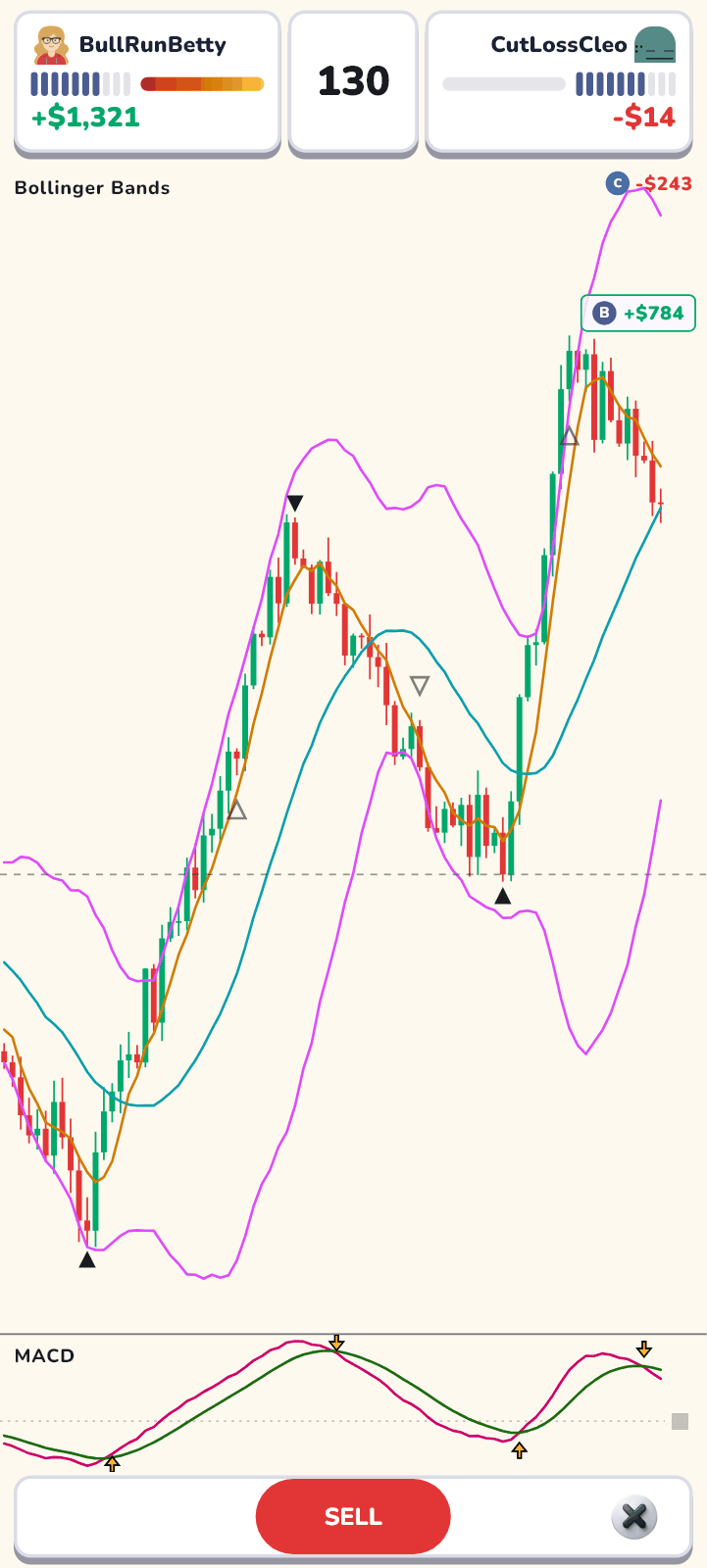
After the match
When the match ends, the stock and the chart window are revealed. Look back at where you bought and sold, and check whether your read of the trend was right. Your next match will go faster.